A collection of thoughts, references, and ideas gathered during the research process. On PhyleNET, on the early internet, on what gets remembered and what gets lost, and on what it might mean to build networked spaces around human needs rather than growth.
started 17 days ago, updated 8 days ago, and containing 49 pins
Pinned in pond originals
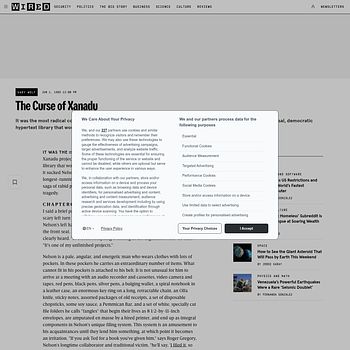

https://community.humanetech.com
It’s easy to fall into the pattern of thinking about the social feeds we have now. But content is not a human need. A truely “social” network wouldn’t look anything like the products that currently exist. How can we actually create meaningful social interactions between people? Deepen the relationships with people you care about? Create real-life experiences that we look back on with satisfaction… not regret?
https://www.wired.com/story/the-online-utopia-doesnt-exist/
Companies such as Google and Facebook arose to organise all the information freely shared by ordinary people, but the result is not widespread employment. What happens instead is a new kind of wealth concentration. Ordinary people DO get benefits in this regime, but they are the benefits of an informal economy, not a first-world economy: you can show off, and a token number of people will find rewards for having done so. Occasionally a Kickstarter project or YouTube video will bring a windfall, but overall, only a tiny, token number of people will benefit from the system.
https://copyrightandtechnology.com/2013/05/28/jaron-laniers-blanket-licensing-scheme/
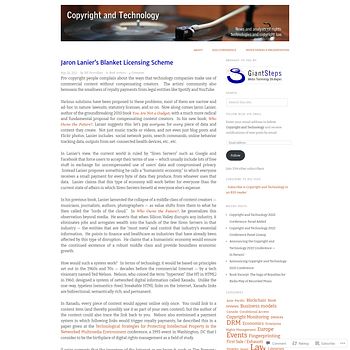
In Jaron Lanier’s view, the current world is ruled by “Siren Servers” such as Google and Facebook that force users to accept their terms of use — which usually include lots of free stuff in exchange for uncompensated use of users’ data and compromised privacy.
Instead Lanier proposes something he calls a “humanistic economy,” in which everyone receives a small payment for every byte of data they produce, from whoever uses that data.
[…]
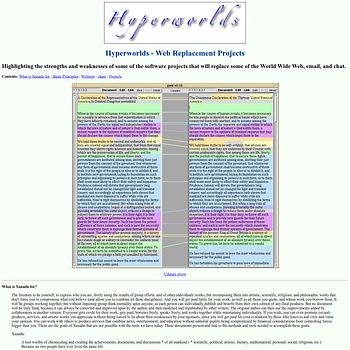
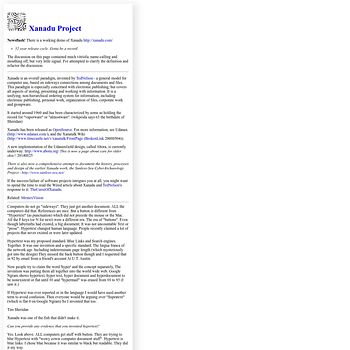
How would such a system work? In terms of technology, it would be based on principles set out in the 1960s and 70s — decades before the commercial Internet — by a tech visionary named Ted Nelson. Nelson […] designed a system of networked digital information called Xanadu. Unlike the one-way, typeless (semantics-free),
breakable HTML links on the Internet, Xanadu links are bidirectional, semantically rich, and permanent. In Xanadu, every piece of content would appear online only once. You could link to a content item (and thereby possibly use it as part of your own content), but the author of the content could also trace the link back to you. Nelson also envisioned a payment system in which following links would trigger royalty payments.
[…]
Moreover, because everything is linked (in a network assumed to be ubiquitous), there would be no need to make copies of anything, except possibly for backup purposes. In other words, this system would render copyright irrelevant. Imprecise concepts like fair use and hardware levies would be subsumed into rules for payment.
https://aeon.co/ideas/say-goodbye-to-the-information-age-its-all-about-reputation-now
There is an underappreciated paradox of knowledge that plays a pivotal role in our advanced hyper-connected liberal democracies: the greater the amount of information that circulates, the more we rely on so-called reputational devices to evaluate it. What makes this paradoxical is that the vastly increased access to information and knowledge we have today does not empower us or make us more cognitively autonomous. Rather, it renders us more dependent on other people’s judgments and evaluations of the information with which we are faced.
We are experiencing a fundamental paradigm shift in our relationship to knowledge. From the ‘information age’, we are moving towards the ‘reputation age’, in which information will have value only if it is already filtered, evaluated and commented upon by others. Seen in this light, reputation has become a central pillar of collective intelligence today. It is the gatekeeper to knowledge, and the keys to the gate are held by others. The way in which the authority of knowledge is now constructed makes us reliant on what are the inevitably biased judgments of other people, most of whom we do not know.
https://www.e-flux.com/journal/40/60272/what-is-the-social-in-social-media
The term “social” has effectively been neutralized in its cynical reduction to data porn. Reborn as a cool concept in the media debate, the social manifests itself neither as dissent nor as subcultural. The social organizes the self as a techno-cultural entity, a special effect of software, which is rendered addictive by real-time feedback features.